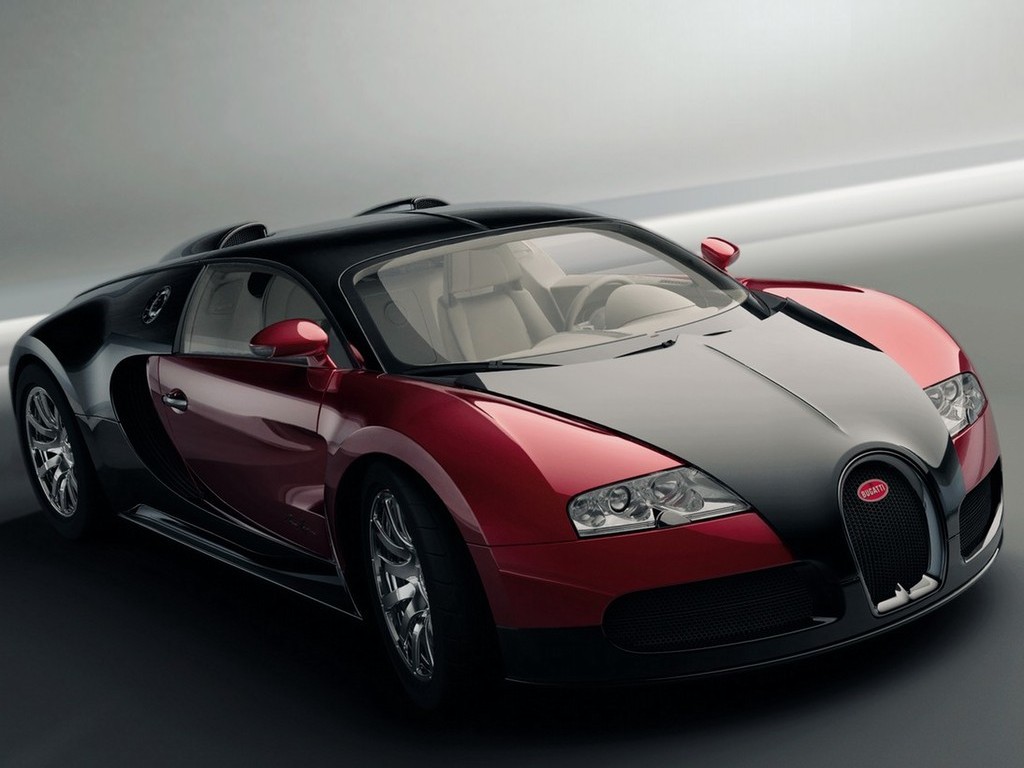
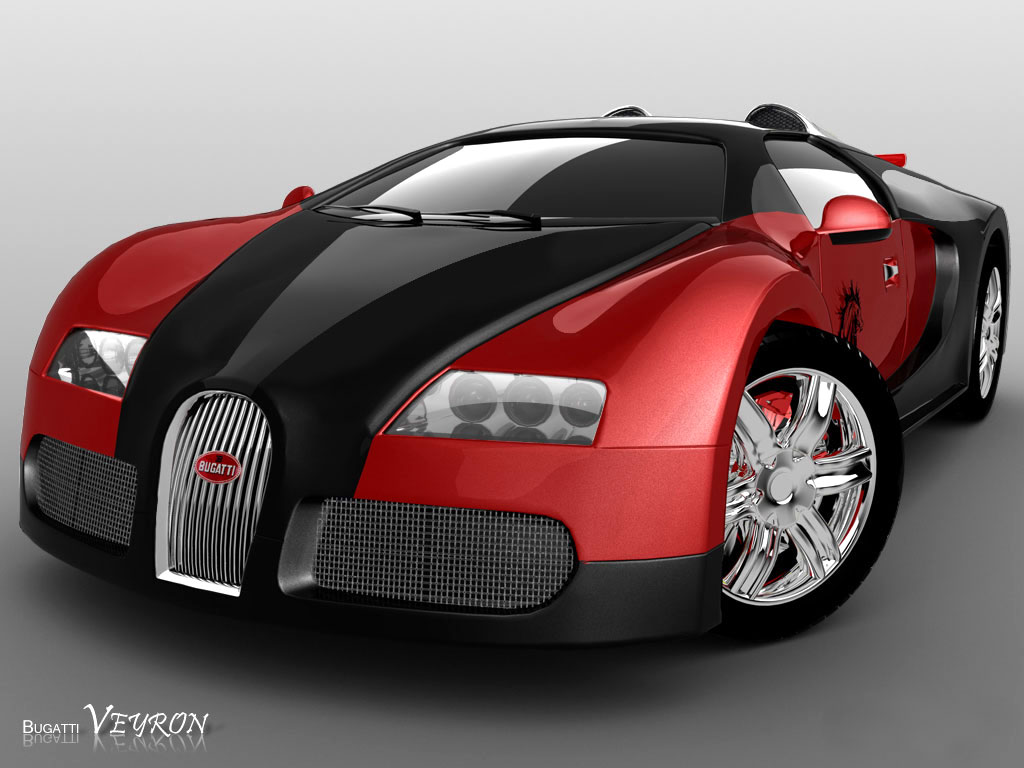
The Bugatti Veyron’s high-tech components being meticulously assembled into an automotive work of art. Watching the car coming together, coupled with an admiration for the technical beauty of its structure, gave the designers the idea of finishing the car in its pure material configuration – meaning no color coating. The result is the EB 16.4. Veyron “Pur Sang”, a two-tone study of pure materialness showing the car’s true essentials: carbon and aluminum.
The carbon monocoque holds the engine plus the passenger cell, while the polished aluminum panelling is enhanced by reflections in the sculpted bodywork. Interestingly, the rawness of the materials even more strongly highlights the dual character of this car: performance power coupled with cruising comfort, structure and body, dark and light.
The Bugatti Veyron EB 16.4 is a mid-engined grand touring car. The Super Sport version is the fastest production car in the world, with an average top speed of 431.072 kilometres per hour (267.856 mph) .The original version has a top speed of 408.47 km/h (253.81 mph).
Designed and developed by the German Volkswagen Group and produced by Bugatti Automobiles SAS at their headquarters in Château St. Jean in Molsheim (Alsace, France), the Veyron's chief designer was Hartmut Warkuss, and the exterior was designed by Jozef Kabaň of Volkswagen, with much of the engineering work being conducted under the guidance of a former VW engineer and now Bugatti Engineering chief Wolfgang Schreiber.
The car is named after French racing driver Pierre Veyron, who won the 24 hours of Le Mans in 1939 while racing for the original Bugatti company. It was named "Car of the Decade" (2000–2009) by the BBC television programme Top Gear.
A number of special variants have been produced, including two targa tops.
bugatti veyron pics bugatti veyron sports cars bugatti veyron picture top bugatti veyron auto car bugatti veyron 2009
The Veyron's brakes use cross drilled, radially vented carbon fibre reinforced silicon carbide (C/SiC) composite discs, manufactured by SGL Carbon, which have a much greater resistance to brake fade when compared with conventional cast iron discs. The lightweight aluminium alloy monobloc brake calipers are made by AP Racing; the fronts have eight titanium pistons and the rear calipers have six pistons. Bugatti claims maximum deceleration of 1.3 G on road tyres. As an added safety feature, in the event of brake failure, an anti-lock braking system (ABS) has also been installed on the handbrake.
Bugatti Veyron
Bugatti Veyron
Bugatti Veyron Prototypes have been subjected to repeated 1.0 G braking from 312 km/h (194 mph) to 80 km/h (50 mph) without fade. With the car's acceleration from 80 km/h (50 mph) to 312 km/h (194 mph), that test can be performed every 22 seconds. At speeds above 200 km/h (120 mph), the rear wing also acts as an airbrake, snapping to a 55-degree angle in 0.4 seconds once brakes are applied, providing an additional 0.68 G (4.9 m/s²) of deceleration (equivalent to the stopping power of an ordinary hatchback).
Bugatti claims the Veyron will brake from 400 km/h (250 mph) to a standstill in less than 10 seconds, though in this time you will have covered a third of a mile.
The All New 2010 Bugatti Veyron to Feature the W16 Engine and 4 Turbochargers! The Veyron from the house of Bugatti is expected to come in the 16 cylinder W16 engine mounted in separate two banks of eight cylinders. The engine features with the 4 turbochargers and displaces 8.0 liter with the stroke and the bore of 86 mm and the 86 mm respectively. The vehicle is designed by Ricardo.The
Some times are for Michelob, and other times are for Cristal. The vehicle you see above and in the gallery below — the Bugatti Veyron Pegaso Edition — is one of the latter. Similarly, we're assuming there are some times we guess it's important for Russian oil barons to set themselves apart from the rest of the mere "filthy rich," and show the world they're actually part of the "ridiculously rich"